
Cactus Search
- 시간 제한
- 4s
- 메모리 제한
- 512MB
- 제출
- 1
- 정답
- 1
- 맞힌 사람
- 1
- 정답 비율
- 100.0%
문제
If you want to make an array problem harder — solve it on a tree. If you want to make a tree problem harder — solve it on a cactus — Conventional wisdom
NEERC featured a number of problems in previous years about cactuses — connected undirected graphs in which every edge belongs to at most one simple cycle. Intuitively, a cactus is a generalization of a tree where some cycles are allowed. An example of a cactus from NEERC 2007 problem is given on the picture below.
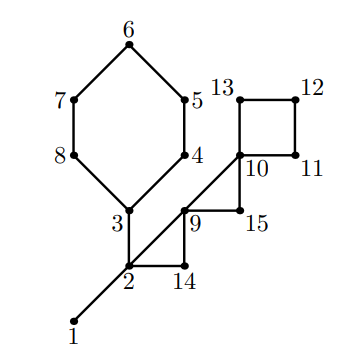
You are playing a game on a cactus with Chloe. You are given a cactus. Chloe had secretly picked one vertex from the cactus and your goal is to find it. You can make at most 10 guesses. If your guess is vertex — you win. Otherwise, if your guess is another vertex — Chloe helps you and tells you some vertex which is adjacent to and such that the distance from to is strictly less than the distance from to (here the distance is the number of edges in the shortest path between vertices).
상호작용
First, the testing system writes a line with two integers and . Here is the number of vertices in the graph. Vertices are numbered from 1 to . Edges of the graph are represented by a set of edge-distinct paths, where is the number of such paths. Each of the following lines contains a path in the graph. A path starts with an integer followed by integers from 1 to . These integers represent vertices of a path. Adjacent vertices in a path are distinct. The path can go to the same vertex multiple times, but every edge is traversed exactly once in the whole input. The graph in the input is a cactus.
To prove that your program can find a secret vertex in at most 10 queries, you need to do that times. Each time testing system picks some vertex before interacting with your program. Your program makes guesses by writing lines with a single number ().
Testing system responds by writing lines with one of the two responses:
- "
FOUND" — means that your guess is correct. After that, your program should proceed to the next test case or terminate if vertices were already guessed. - "
GO" — means that your guess is incorrect, but now you know that the distance from vertex to the secret vertex is less than the distance from . It is guaranteed that vertices and are connected by an edge.
Do not forget to flush the output after each guess!
예제 입력 1
5 2
5 1 2 3 4 5
2 1 3

FOUND

GO 4

FOUND

GO 2

FOUND

GO 1

FOUND

GO 4

GO 5

FOUND
예제 출력 1
3

3

4

3

2

3

1

3

4

5
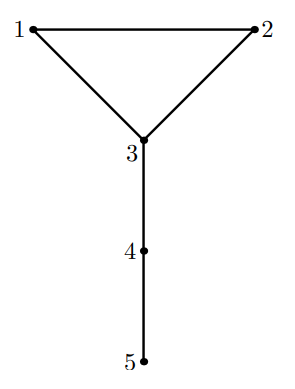
노트
Empty lines are added to the standard input and the standard output examples for clarity only. They are not present during the actual interaction.
코드를 제출하려면 로그인이 필요합니다.
로그인제출 내역이 없습니다.
| # | 순위 | 사용자 | 언어 | 시간 | 메모리 | 코드 길이 | |
|---|---|---|---|---|---|---|---|
| 8714 | 🥇 | 조서현 | C++ | 146ms | 17912KB | 2409B |
1명 투표· 4개월 전| # | 사용자 | 문제 | 결과 | 언어 | 시간 | 메모리 | 코드 길이 | 제출 시간 | |
|---|---|---|---|---|---|---|---|---|---|
| 8714 | 맞았습니다 | C++ | 146ms | 17912KB | 2409B | 2026. 06. 02. 07:15 |