
LISTA
- 시간 제한
- 1s
- 메모리 제한
- 32MB
- 제출
- 0
- 정답
- 0
- 맞힌 사람
- 0
- 정답 비율
- 0.0%
문제
Mirko received a birthday present from his aunt in the US – a brand-new doubly-linked list. The list contains nodes numbered through . Two types of moves can be done on the list:
- A) Move node in front of node .
- B) Move node after node .
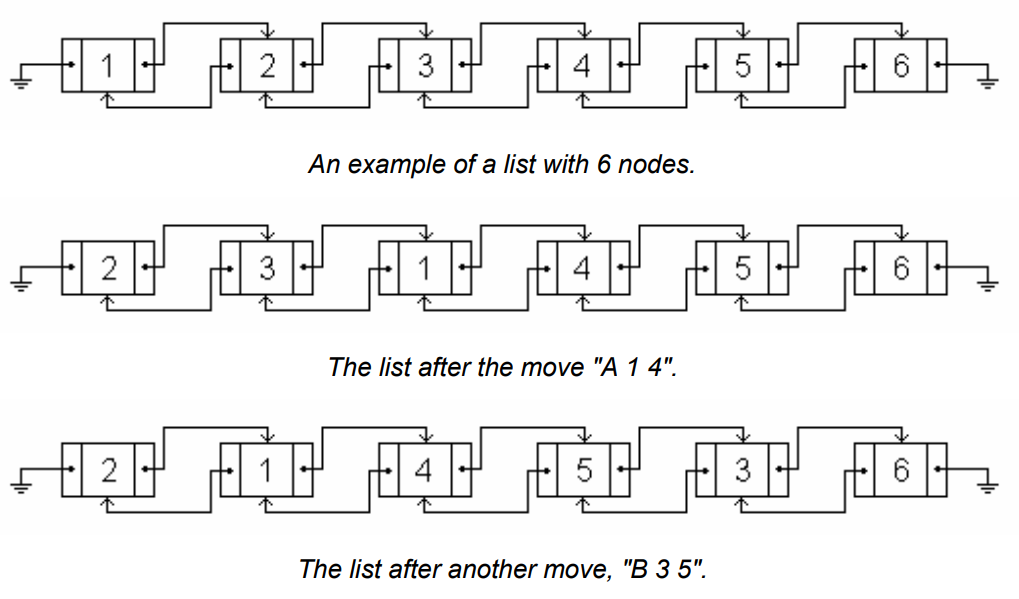
Mirko played with his new toy for hours, writing down each move on a piece of paper so that he can reconstruct the list's initial state (nodes through in order from left to right).
When he decided to reconstruct the list, Mirko was astonished to find that there is no easy way to invert the moves and restore the list's initial state. Mirko cannot know where node was prior to each move, only where it ended up.
Seeing how Mirko is still recovering from the shock, write a program that finds a minimal sequence of moves that restored the list's initial state from Mirko's logs.
입력
The first line of input contains two integers and (, ), the number of nodes and the number of moves made by Mirko.
Each of the next rows contains a description of a single move made by Mirko – the type of move ('A' or 'B') and two integers and .
출력
Output the minimum number of moves (call this number ) on the first line.
Each of the next lines should contain a description of a single move in the same format as in the input.
Note: The sequence need not be unique.
채점
If both the number and the sequence of moves are correct, your program will score full points on the test case.
If your program outputs the correct number and does not output the sequence of moves, or the sequence of moves is incorrect, you will get 60% of the points for that test case.
예제 입력 1
2 1
A 2 1
예제 출력 1
1
A 1 2
예제 입력 2
4 3
B 1 2
A 4 3
B 1 4
예제 출력 2
2
A 1 2
B 4 3
예제 입력 3
6 5
A 1 4
B 2 5
B 4 2
B 6 3
A 3 5
예제 출력 3
3
A 4 5
B 6 5
A 2 3
이 문제는 현재 제출할 수 없습니다.
이 현상이 잘못되었다고 생각될 경우 관리자한테 문의주세요.
제출 내역이 없습니다.
아직 맞은 사람이 없습니다.
1명 투표· 5개월 전제출 내역이 없습니다.